
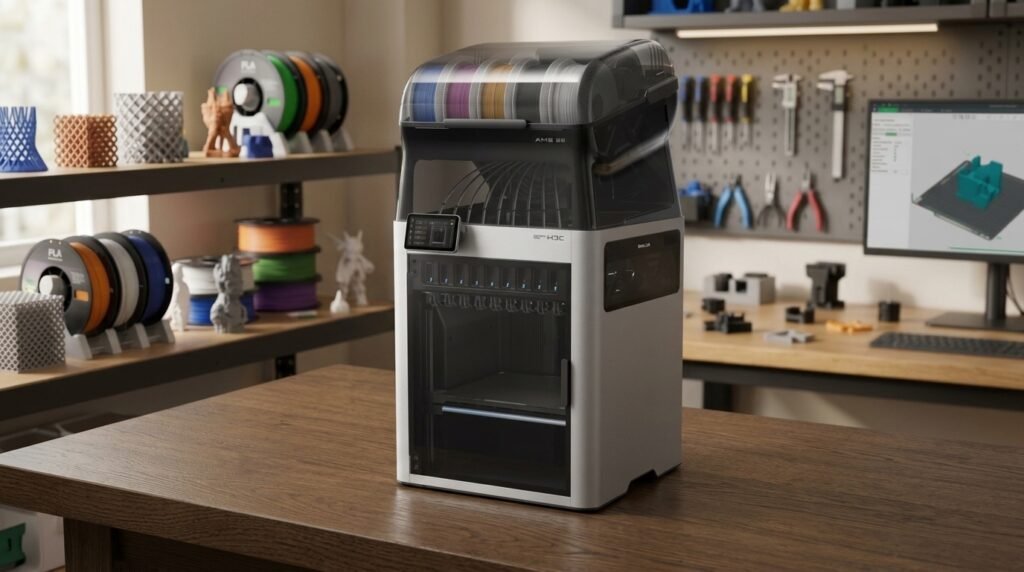
Bambu Lab has disrupted the additive manufacturing market once again with the official release of the Bambu Lab H3C, their flagship third-generation 3D printer featuring a true Tool Changer architecture. Built from the ground up to eliminate the bottlenecks of multi-color and multi-material printing, the H3C moves away from single-nozzle retraction systems in favor of 9 independent tools.
Is this new flag-ship machine worth the $2,499 price tag? How does it handle engineering materials and ultra-soft TPU?
In this in-depth review, we analyze the technical specifications of the Bambu Lab H3C, how the SwapTek ecosystem operates, the new FlexFeed extruder, and whether it sets a new standard for modern 3D printing workflows.
📌 Key Takeaways
- SwapTek Architecture: Automatic tool changer with 9 independent PrintTools delivering material swaps in under 6 seconds.
- FlexFeed Extruder: Native support for ultra-soft TPU (down to 75A Shore hardness) with high volumetric flow using 1.75 mm and 2.85 mm bypass channels.
- Active Chamber Heating: Enclosed thermal environment heated up to 65 °C for technical polymers like PA-CF, PC, ASA, and PPS.
- AMS 3H Storage Unit: Integrated 9-spool dry management system with active drying in two slots up to 85 °C.
1. What Is the SwapTek System and How Does It Work?
Traditional multi-filament 3D printers (like the Bambu Lab X1 or P1 series with AMS) require filment to be cut, retracted through meters of PTFE tubing, swapped, and purged through a single nozzle for every color change. This process wastes both time and filament.
With the SwapTek architecture, Bambu Lab introduces 9 independent PrintTools. Each tool contains its dedicated filament drive path, heater block, and nozzle orifice.
- Lightning Fast Swaps: Toolhead changes take under 6 seconds.
- Active Pre-Heat: The incoming tool pre-heats before docking, preventing thermal delays.
- Zero Material Contamination: Combine different nozzle sizes (e.g., a 0.4 mm nozzle for fine outer perimeters and a 0.8 mm nozzle for infill) or incompatible materials in a single print.
2. FlexFeed: Hassle-Free Ultra-Soft TPU (75A)
Feeding flexible filaments through bowden or direct-drive extruders has historically caused buckling and jams. The H3C tackles this via the FlexFeed system.
The printer supports standard 1.75 mm filament as well as dedicated 2.85 mm TPU through bypass ports. The thicker 2.85 mm filament provides structural column strength under pushing pressure, enabling reliable printing of TPU as soft as 75A at up to 3 times the volumetric flow rate of conventional setups.
3. Bambu Lab H3C Technical Specifications
| Parameter | Official Specification |
|---|---|
| Build Volume | 330 × 320 × 325 mm |
| Extrusion System | SwapTek Tool Changer (9 Tools) |
| Speed / Acceleration | Up to 1,400 mm/s | 25,000 mm/s² Acceleration |
| Nozzle Temperature | Up to 350 °C (Hardened Steel Nozzle) |
| Heated Bed Temperature | Up to 120 °C |
| Chamber Heating | Active heating up to 65 °C |
| Filament System | AMS 3H with dual-slot drying up to 85 °C |
4. Who Is the Bambu Lab H3C For?
The H3C isn’t merely designed for multi-color PLA trinkets; it is a serious production tool for demanding applications:
- Functional Prototyping: Combine rigid structural cores (such as PA-CF) with soft flexible seals or gaskets (TPU) in one continuous print.
- High-Throughput Print Farms: Drastically reduced tool-swap times save hours on complex multi-material production runs.
- Soluble Support Integration: Use dedicated soluble support materials without contaminating the primary structural filament path.
Final Verdict
The Bambu Lab H3C raises the bar for desktop additive manufacturing. By combining a 9-position fast Tool Changer, an actively heated 65 °C chamber, and extreme flexible filament support, it addresses key limitations of previous generations. For makers and professionals looking for seamless multi-material capabilities, the H3C is the machine to beat.