Stepping into the world of desktop 3D printing opens up an incredible universe of creation, functional prototyping, and artistic design. However, long before you start slicing complex 3D models, every maker faces a fundamental question: What type of filament should I use?
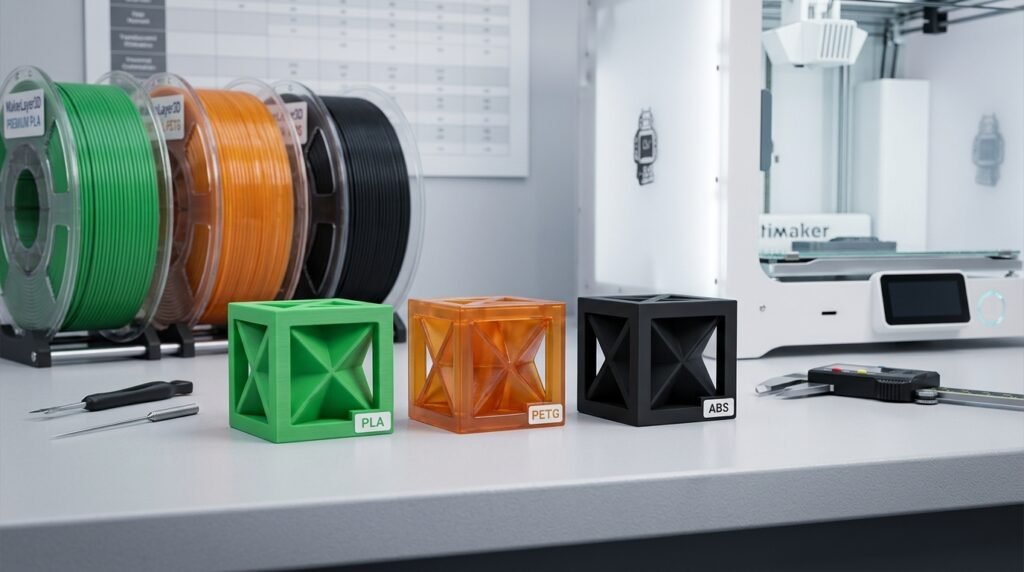
The market offers a dizzying array of thermoplastic materials, but three heavyweights dominate desktop additive manufacturing: PLA (Polylactic Acid), PETG (Polyethylene Terephthalate Glycol), and ABS (Acrylonitrile Butadiene Styrene). Choosing the right filament impacts everything from print success rates and bed adhesion to mechanical strength, thermal resistance, and post-processing finish.
In this in-depth, data-driven guide, we compare PLA vs PETG vs ABS, breaking down their properties, ideal use cases, temperature requirements, and printer compatibility to help you make the right choice for your next project.
Key Takeaways
- PLA is the King of Beginners: Easy to print, low warping, odorless, and biodegradable, making it ideal for miniatures, visual models, and prototypes.
- PETG is the Ultimate All-Rounder: Combines the ease of printing close to PLA with the mechanical strength, durability, and moisture resistance approaching ABS.
- ABS is for Engineering Parts: Offers high impact resistance and heat tolerance, but requires an enclosed 3D printer and proper ventilation due to toxic fumes.
- Enclosure Matters: PLA and PETG thrive in open-air printers, while ABS demands a stable, heated chamber to prevent severe warping and layer splitting.
1. Quick Material Comparison Overview
Before analyzing each filament individually, let us look at how they compare across core performance metrics:
| Property | PLA | PETG | ABS |
| Ease of Printing | Extremely Easy | Easy to Moderate | Moderate to Difficult |
| Printing Temperature | 190 °C – 220 °C | 230 °C – 250 °C | 240 °C – 260 °C |
| Bed Temperature | 50 °C – 60 °C | 70 °C – 80 °C | 90 °C – 110 °C |
| Enclosure Required? | No | No | Yes (Highly Recommended) |
| Tensile Strength | Moderate | High | High |
| Flexibility / Impact | Rigid / Brittle | Tough / Flexible | Tough / High Impact |
| UV & Weather Resistance | Poor to Fair | Good | Moderate (Yellows in UV) |
| Odor / Fumes | Sweet / Harmless | Low Odor | Strong Styrene Fumes |
2. PLA (Polylactic Acid): The Beginner’s Best Friend
PLA is universally recognized as the default starting filament for almost every desktop 3D printer owner—including popular budget machines like the Bambu Lab A1 Mini and Creality Ender series. Derived from renewable organic sources such as corn starch or sugarcane, PLA is non-toxic, eco-friendly, and emits a mild, sweet scent when heated.
Advantages of PLA
- Low Printing Temperatures: Melts cleanly between 190°C and 220°C, requiring minimal bed heating (50°C–60°C).
- Minimal Warping: Excellent thermal stability means it sticks reliably to PEI build plates without requiring an enclosure.
- Stunning Aesthetics: Available in hundreds of colors, silk finishes, matte variations, and wood-infused composites.
Disadvantages of PLA
- Low Heat Resistance: PLA begins to soften and deform around 50°C–60°C, making it unsuitable for hot car interiors or items exposed to direct summer sunlight.
- Brittle Nature: Lacks high impact resistance; under severe stress, PLA snaps rather than flexes.
Best Use Cases for PLA
- Tabletop gaming miniatures, cosplay display pieces, and decorative models.
- Architectural prototypes, geometric models, and low-stress desk organizers.
3. PETG (Polyethylene Terephthalate Glycol): The Durable Workhorse
If PLA is your artistic paintbrush, PETG is your mechanical wrench. PETG bridges the gap between the user-friendly printing characteristics of PLA and the rugged durability of engineering plastics like ABS.
Advantages of PETG
- Superior Interlayer Adhesion: Layers fuse together exceptionally well, resulting in robust, tough mechanical parts that resist snapping under load.
- Chemical & Moisture Resistance: Highly resistant to water, grease, mild acids, and everyday solvents, making it ideal for outdoor applications.
- Moderate Temperature Threshold: Withstands temperatures up to 75°C–80°C before softening.
Disadvantages of PETG
- Stringing and Oozing: PETG has a tendency to string across travel moves if retraction settings are not properly calibrated.
- Aggressive Bed Adhesion: It sticks too well to smooth glass or PEI sheets; printing directly on glass without a release agent (like glue stick) can chip the glass surface.
Best Use Cases for PETG
- Mechanical brackets, functional hinges, drone parts, and tool mounts.
- Waterproof items, planters, and outdoor garden accessories.
4. ABS (Acrylonitrile Butadiene Styrene): The Industrial Standard
ABS is a heavy-duty thermoplastic widely used in injection-molded commercial goods (such as Lego bricks and automotive components). In the 3D printing realm, it offers superb thermal resistance and toughness, but it demands respect from the operator.
Advantages of ABS
- High Heat Resistance: Withstands continuous temperatures up to 85°C–90°C without deforming.
- Easy Post-Processing: ABS dissolves in acetone, allowing makers to achieve a mirror-smooth, injection-molded finish using an acetone vapor bath.
- Impact Strength: Excellent flexibility and shock absorption under physical stress.
Disadvantages of ABS
- Severe Warping & Shrinking: As ABS cools down, it contracts aggressively. Without a heated enclosure (chamber temp 45°C+), corners lift off the build plate and layers split apart (delamination).
- Toxic Fumes: Printing ABS releases ultrafine particles and pungent styrene vapors that require a well-ventilated room or a dedicated HEPA/carbon air filtration system.
Best Use Cases for ABS
- Functional mechanical parts subject to high heat or friction.
- Automotive clips, custom electronic enclosures, and items requiring chemical smoothing.
5. Summary Verdict: Which One Should You Buy?
To make your decision effortless, follow this golden rule:
- Start with PLA if you are learning how to slice, calibrating your first printer, or printing models where visual detail and ease of use matter most.
- Switch to PETG when you need stronger functional parts, clips, brackets, or items exposed to sunlight and moisture, without wanting to deal with toxic fumes.
- Upgrade to ABS only if you own an enclosed printer (like a Bambu Lab P1S or Creality enclosed unit), have proper room ventilation, and specifically require acetone smoothing or high-heat resistance.
Frequently Asked Questions (FAQ)
Can I print ABS on an open-bed 3D printer like the A1 Mini?
It is strongly discouraged. Open-bed printers suffer from ambient air drafts that cause ABS to warp and crack mid-print. Stick to PLA and PETG on open cantilever machines.
Which filament is waterproof?
Both PETG and ABS are water-resistant and food-safe in their raw pellet form (though printed layers can still trap bacteria in micro-gaps). PLA absorbs moisture over time and degrades in damp environments.
Does filament expire?
Yes. Hygroscopic filaments like PETG, ABS, and Nylon absorb moisture from the air, causing bubbling and popping during extrusion. Store them in sealed dry boxes with silica gel packs.