
Multi-color and multi-material 3D printing is undergoing one of the most significant architectural shifts of the past decade. For years, the vast majority of accessible desktop printers relied on a single shared nozzle—forcing the machine to cut the filament, retract it dozens of centimeters back through PTFE tubing, feed a new spool, and purge substantial amounts of molten plastic during every single color transition. While automated filament changers like AMS and CFS units successfully popularized multi-color printing, they still suffer from two severe bottlenecks: sluggish layer-by-layer swap times and massive amounts of wasted plastic turned into purge towers and flushed filament scraps.
The Flashforge Creator 5 enters the market specifically to break away from that paradigm. Rather than trying to optimize a single hotend to handle multiple polymers sequentially, Flashforge engineered a true Toolchanger architecture featuring 4 completely independent print toolheads, branded as the FlashSwap system.
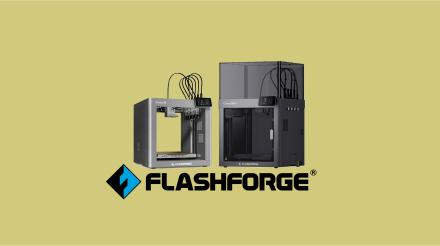
Promising up to 500% faster multi-color printing and near-zero purge waste, the new lineup arrives in two distinct configurations: the standard Flashforge Creator 5 (featuring an open-frame design geared toward speed and everyday filaments) and the Flashforge Creator 5 Pro (featuring a fully enclosed chassis, H13 HEPA air filtration, and an actively heated build chamber for engineering materials).
In this comprehensive technical review, we dissect the mechanical operation of its 4 independent extruders, the accuracy of its automated multi-tool offset calibration, the core differences between the standard and Pro models, OrcaSlicer integration, and whether the Creator 5 truly delivers the best return on investment for makers, design studios, and print farms.
📌 Flashforge Creator 5 Key Takeaways
- 4-Toolhead FlashSwap Architecture: Four complete, independent extruders that automatically dock and swap without requiring purge towers or filament flushing.
- Dramatic Time and Material Savings: Near-instant toolhead swaps eliminate purge waste, saving up to 90% or more of wasted plastic on intricate multi-color models.
- High-Rigidity CoreXY Kinematics: Robust metal frame engineered to sustain print speeds up to 300 mm/s, rapid travel speeds up to 600 mm/s, and 30,000 mm/s² acceleration.
- Fully Automated Multi-Nozzle Calibration: Hands-free bed leveling, automated X, Y, and Z offset alignment across all 4 nozzles, and dynamic flow compensation (Auto PA Calibration).
- Two Strategic Variants: While the standard Creator 5 excels with PLA, PETG, and TPU, the Creator 5 Pro adds a full enclosure, an actively heated chamber up to 65 °C, and dual H13 HEPA + activated carbon filtration.
1. How Does the FlashSwap 4-Toolhead Architecture Work?
The defining engineering advantage of the Flashforge Creator 5 over traditional single-nozzle multi-color printers lies in the complete physical separation of its melt paths. Each of the 4 print toolheads integrates its own dedicated extruder motor, drive gears, heater block, and nozzle assembly, remaining parked on the rear docking station (dock module) whenever idle.
When the sliced G-code calls for a color or polymer transition mid-layer:
- The active CoreXY carriage travels rapidly to the rear docking station and parks the current toolhead in its designated slot.
- The mechanical and magnetic coupling mechanism immediately locks onto the next pre-heated toolhead already loaded with the secondary material.
- Printing resumes smoothly on the model without cutting filament, retracting long PTFE runs, or running time-consuming nozzle purging routines.
Real-World Advantages on the Workbench
- Up to 500% Faster Multi-Color Prints: On complex models where a single layer requires three or four color changes, single-nozzle printers often spend more time swapping filament than extruding plastic. On the Creator 5, tool swaps take just a few seconds, cutting multi-day print jobs down to a fraction of the time.
- Zero Cross-Contamination Between Polymers: Mixing chemically incompatible materials inside a single shared nozzle—such as PLA and PETG, or rigid structural polymers paired with soluble support filaments—inevitably leaves microscopic residue inside the melt zone, weakening layer adhesion. With 4 isolated toolheads, every filament runs through its own dedicated thermal path.
- Mixing Nozzle Diameters in One Print: Because all four nozzles are independent and quick-swappable (available in 0.25 mm, 0.4 mm, 0.6 mm, and 0.8 mm), you can assign a fine nozzle to crisp outer perimeters and small embossed text while a wider nozzle rapidly lays down internal infill.
2. CoreXY Kinematics, Volumetric Flow, and High-Temp Nozzles
To ensure that the added mechanical complexity of a tool-changing carriage never degrades surface finish through ghosting or ringing artifacts, Flashforge built the Creator 5 around a high-rigidity CoreXY chassis paired with precision linear rails and active vibration compensation.
- Speed and Acceleration: The printer reliably sustains printing speeds up to 300 mm/s, rapid non-printing travel moves up to 600 mm/s, and peak accelerations of 30,000 mm/s².
- 320 °C Hardened Steel Hotends: All four toolheads come factory-equipped with wear-resistant 0.4 mm hardened steel nozzles capable of reaching 320 °C and delivering a maximum volumetric flow rate of 32 mm³/s. This enables printing everything from standard PLA and PETG to abrasive carbon-fiber composites (such as PLA-CF and PETG-CF) without premature nozzle wear.
- 120 °C Heated Bed with Textured PEI Sheet: The 256 × 256 × 256 mm build platform utilizes a fast-heating bed rated up to 120 °C, topped with a flexible textured PEI spring steel sheet for strong first-layer adhesion and effortless part removal once cooled.
3. Automated Multi-Toolhead Calibration and Flow Control
Historically, multi-extruder and IDEX 3D printers forced users to spend hours printing calibration patterns and manually dialing in dozens of fractional millimeter offsets across the X, Y, and Z axes just to prevent visible layer shifts between colors.
The Flashforge Creator 5 eliminates that setup friction through a fully automated calibration suite:
- Automatic Bed Leveling: High-precision mesh probing maps the entire 256 × 256 mm build surface prior to printing to guarantee a consistent first layer.
- Automated 4-Nozzle Offset Alignment: The machine automatically measures and compensates for any microscopic horizontal or vertical positional variances across all four toolheads, ensuring seamless alignment between colors and materials.
- Auto PA Calibration (Dynamic Pressure Advance): The printer calibrates and compensates for internal nozzle pressure dynamically, preventing bulging corners and inconsistent extrusion during sharp direction changes.

4. Flashforge Creator 5 vs. Creator 5 Pro: Which One Should You Choose?
Before investing in the Creator 5 series, it is important to understand the intended workload of each variant. While both models share the exact same CoreXY motion system, build volume, and four 320 °C independent toolheads, chamber thermal management determines which engineering materials you can print reliably.
| Technical Specification | Flashforge Creator 5 (Standard) | Flashforge Creator 5 Pro |
|---|---|---|
| Frame Design | Open Frame | Fully Enclosed |
| Build Volume | 256 × 256 × 256 mm | 256 × 256 × 256 mm |
| Extrusion System | 4 Independent Toolheads (FlashSwap) | 4 Independent Toolheads (FlashSwap) |
| Max Nozzle Temperature | Up to 320 °C (Hardened Steel) | Up to 320 °C (Hardened Steel) |
| Max Bed Temperature | Up to 120 °C | Up to 120 °C |
| Active Chamber Heating | None | Yes, active heating up to 65 °C |
| Air Filtration | None | H13 HEPA + Activated Carbon Filter |
| Door Sensor & Safety | Filament runout & power-loss recovery | All C5 features + Magnetic door sensor |
| Max Power Consumption | 700 W | 1,200 W |
| Recommended Materials | PLA, PETG, TPU, PLA-CF, PETG-CF, PVA, BVOH | All C5 materials + ABS, ASA, PC, PA-CF, PAHT-CF, PPS-CF |
Which Model Fits Your Workflow Best?
- Choose the standard Creator 5 if your primary focus is high-speed multi-color printing using PLA, PETG, Silk filaments, flexible TPU, and soluble supports. Because these polymers benefit from ample ambient cooling, the open-frame architecture prevents heat creep inside the extruders during long production runs.
- Choose the Creator 5 Pro if you need to manufacture functional mechanical parts in ABS, ASA, Nylon (PA), Polycarbonate (PC), or PPS-CF. The enclosed chassis with active 65 °C chamber heating prevents warping and layer delamination, while the H13 HEPA filter traps ultrafine particles and fumes inside your workspace.
5. Software Ecosystem, Remote Monitoring, and Practical Considerations
On the software side, the Creator 5 integrates natively with Orca-Flashforge and offers full compatibility with standard OrcaSlicer, making it straightforward to assign extruders by object or smart-paint regions, tune individual retraction settings per toolhead, and manage multiple networked printers simultaneously.
Its connectivity and convenience suite includes:
- Integrated HD Camera (1280×720 at 30 fps): Allows remote real-time print monitoring from your desktop or mobile device to catch potential issues early.
- Dual-Band Wi-Fi (2.4 GHz / 5 GHz) & USB: Fast wireless file transfers directly to onboard storage.
- Quiet Operation: Rated below 55 dB in silent mode, keeping noise levels manageable for design offices, studios, and classrooms.
Practical Considerations in Daily Operation
Despite its strong mechanical engineering, two practical workflow details are worth keeping in mind:
- External Spool Feeding: Unlike motorized enclosed dry-box changers, the 4 filament spools mount on external holders and feed directly into each toolhead. When printing moisture-sensitive polymers like Nylon, PVA, or PETG in humid environments, pairing the setup with external filament dry boxes is recommended.
- Flexible Filament Routing (TPU): While the printer supports TPU 90A, 95A, and 64D, softer flexible filaments require low-friction feeding paths. Mounting TPU spools on the top overhead holder reduces drag inside the PTFE guide tubes and prevents under-extrusion.
Final Verdict: Is the Flashforge Creator 5 Worth It?
The Flashforge Creator 5 marks a major step forward in bringing true multi-toolhead manufacturing to the desktop without industrial-level pricing. By replacing the traditional single-nozzle bottleneck with 4 independent toolheads and automated offset calibration, Flashforge solves the two biggest pain points of multi-color 3D printing at once: excessive print times and costly purge waste.
For design studios, small-batch manufacturers, educational labs, and advanced makers looking to combine multiple colors or pair rigid plastics, flexible elastomers, and soluble supports in a single clean print, the Creator 5 offers one of the most efficient architectures available today—especially in the Creator 5 Pro trim, which adds the 65 °C active thermal control needed to master demanding engineering polymers.